
Staff Writer Bruno Matarazzo Jr.
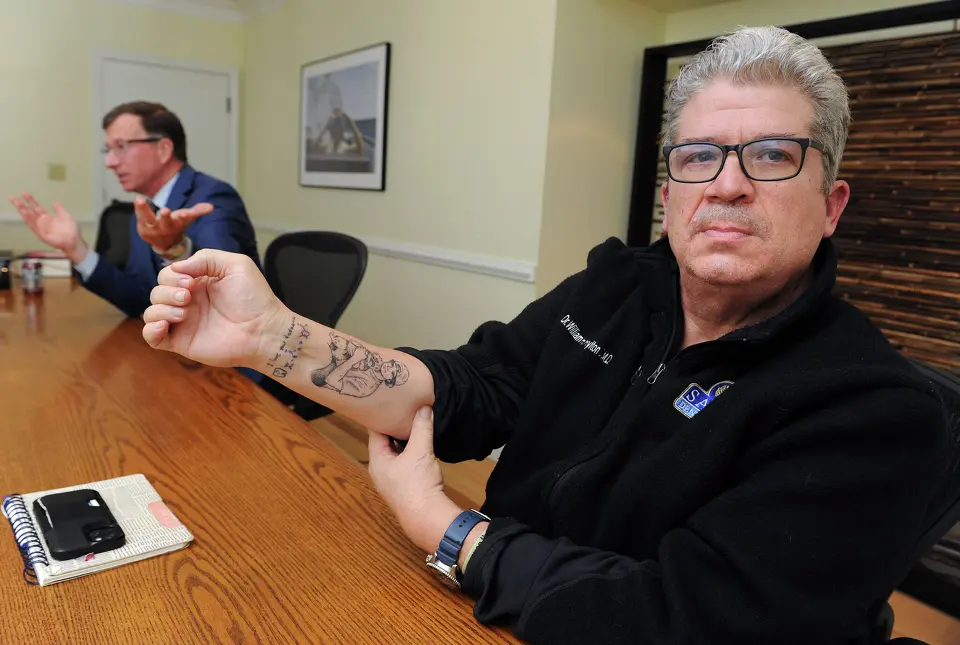
William Hylton shows a tattoo of his deceased son, Conor, with their family dog, Howie, on his arm during an interview with his attorney, Joel Faxon, in New Haven on April 13, 2026.
Arnold Gold/Hearst Connecticut Media
NORTH HAVEN — In the early hours of a sleepless night five years ago, the Hylton family rushed their ill dog to a veterinary hospital where a team of specialists moved quickly, admitted the animal to an intensive care unit and, within hours, reassured them he would survive.
In 2024, the same family found themselves in another emergency, this time with far higher stakes, and a far different outcome.
Their oldest son, Conor, died at the age of 26 after being admitted to Bridgeport Hospital Milford Campus where his father, William, alleges he never received the level of care he should have.
“My son Conor did not receive the same level of care that my dog Howey did,” said William Hylton, as his voice tightened, while he recounted the events that led to his son’s death.
William Hylton now bears a tattoo on his arm honoring Conor, shown as a young boy holding the family dog Howey, a Brussels Griffon. The tattoo has become a juxtaposition that has become impossible for him to ignore and a reminder of two nights that ended very differently.
The family has since filed a medical malpractice lawsuit at state Superior Court in Bridgeport, alleging that Conor went hours in a “fake ICU” without being seen by an in-person physician and that critical care was delayed.
Conor’s father and the family’s attorney, Joel Faxon, said they were never informed that the unit lacked an on-site intensivist and would have requested an immediate transfer to another hospital had they known.
Conor, described as athletic and academically gifted student who was enrolled at UConn dental school, went to the hospital complaining of severe abdominal pain, vomiting and dehydration. After spending hours in the emergency department, the plan, his father said, was an expected admission to the hospital for fluids and observation.
His family had stayed by his side until 7 p.m., and Conor was conscious and alert, making plans to start dental school the following day and worrying about getting a parking pass for the school campus, his father said.
“Those are not the things that a kid who’s about to die thinks about,” William recalled.
Hours later, at 4:45 a.m., the family received a call from the hospital.
William remembers the person on the phone asked him if he knew his son was in the hospital.
By the time his parents arrived, Conor had been transferred to the campus’ intensive care unit and was in the midst of a medical emergency.
What William remembers most is not only the urgency in the room, but what he says was missing: a doctor at the bedside.
Instead, he recalls a physician appearing remotely on a screen, issuing instructions to staff.
“At 6:12, that doctor, on the screen, pronounced my son dead,” William said. “I’ll never forget that.”
Hospital records listed Hilton’s cause of death as a gastrointestinal bleed, but Faxon disputes that, claiming there was “no evidence whatsoever” to support it. Instead, the complaint cited a note by the tele-ICU attending said he “most likely” aspirated, which led to respiratory failure and PEA arrest.
The hospital did not offer the family an autopsy, according to the lawsuit.
After the filing the lawsuit, Yale New Haven Hospital, which owns Bridgeport Hospital and the former Milford Hospital, said in statement through a spokesperson that it “is committed to providing the safest and highest quality of care possible, however, we are unable to comment on pending litigation.”
Faxon points to findings from state and federal investigators that, he says, identified multiple failures in care. Among them were the absence of a dedicated ICU physician, reliance on tele-ICU and confusion over who was responsible for monitoring Conor.
In one instance, a hospitalist, Dr. Frances Denu, who was supposed to provide overnight coverage from Aug. 14-15, 2024, indicated she did not know she was responsible for the patient, Faxon said.
They said there was a delay in having their son intubated after an emergency room doctor had to be called to the Milford campus’ ICU to perform the procedure.
“The end result, my son, who is in the ICU fighting for his life, it takes 21 minutes to get him intubated. This is in an ICU in Milford, Connecticut,” Hylton said. “That’s documented.”
William said he’s not opposed to tele-ICUs since they are likely the only option for parts of the country like the Great Plains and remote parts of the world where hospitals are hundreds of miles from each other.
But in Milford, there is a Level 1 ICU at Yale New Haven Hospital, which is a 15 minute drive from Milford.
“If you have a critically ill kid, send him somewhere where they can treat him. If you know there’s not going to be anyone in the ICU, a doctor, someone giving high-level acute care, send them somewhere else,” William said.
“We were never given the choice,” he added.